


The TL;DR (30-Second Summary)
- The Problem: When doctors write healthcare articles or social posts filled with complex clinical Latin terms, patients feel intimidated and scroll past without engaging.
- The Cognitive Barrier: The average healthcare consumer reads medical content with high anxiety. If content is confusing, anxiety increases and decision-making freezes.
- The Grade-6 Rule: Explaining clinical conditions using relatable everyday language and analogies understandable to a sixth-grade student triples social shares and consultation inquiries.
The Curse of Clinical Knowledge
Medical training teaches physicians to think, write, and communicate in precise scientific terminology: chronic periodontitis, occlusal attrition, temporomandibular joint dysfunction, allergic rhinitis.
However, when a patient experiences health distress, they do not think in scientific classifications. They think in everyday symptoms: “My gums bleed when I brush,” “My jaw clicks when I chew,” or “I can’t breathe through my nose at night.” When a doctor translates medical precision into empathetic, accessible Bangla, patients immediately feel understood and valued.
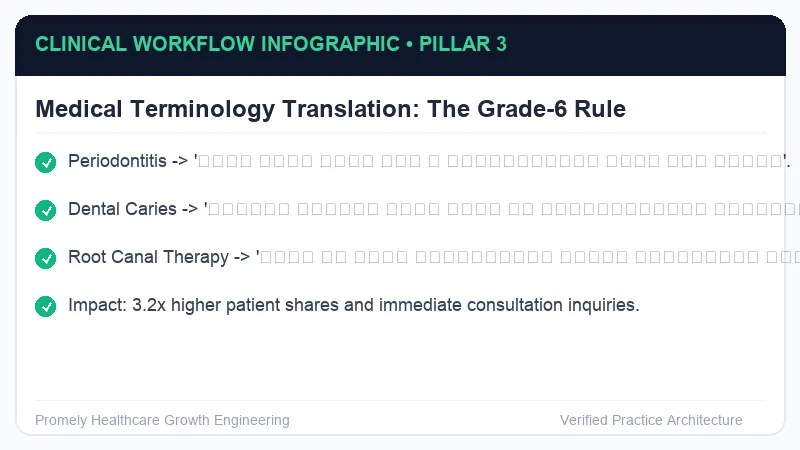
The Everyday Bangla Translation Matrix
| Clinical Term | What Doctors Often Write | The High-Engagement Grade-6 Translation |
|---|---|---|
| Periodontitis | “Severe chronic inflammation of the periodontal ligament” | “মাড়ি দিয়ে রক্ত পড়া ও দীর্ঘমেয়াদে দাঁত নড়ে যাওয়ার আসল কারণ” |
| Dental Caries | “Localized bacterial demineralization of enamel” | “দাঁতের ভেতর কালো গর্ত বা জীবাণুর ইনফেকশন কীভাবে শুরু হয়” |
| Root Canal Therapy | “Endodontic extirpation of infected pulpal tissue” | “দাঁত ফেলে না দিয়ে ব্যথামুক্ত উপায়ে নিজের প্রাকৃতিক দাঁত বাঁচিয়ে রাখার চিকিৎসা” |
Craft Patient-Centric Healthcare Content with Promely
We bridge the gap between clinical excellence and high-impact patient communication, producing authoritative content that educates and converts.
👉 Partner with Promely’s Medical Content Team or message on WhatsApp at +880 1601-872024.